How to Make Safety Audits Effective
A recent study* has found safety audits yield corrective actions that are overwhelmingly concentrated on lower-level administrative improvements, clearly suggesting most safety audits are ill-focused and therefore in-effective.
The study cited some compelling data including:
65 internal and external audits were examined from two major construction and engineering contractors operating across Australia,
384 recommendations (of a total of 448) were classified as “soft controls”, of which
364 recommendations were in the “administrative category”,
Most corrective actions were clustered at project level or below, and
None of the corrective actions were aimed higher eg at construction company, client or regulatory level.
* Study by Ben Hutchinson, Australia, published online in Safety and Health at Work, August 2026.
Not all Safety Audits are the Same
Whilst this study appears to be thorough and professionally conducted and offers some good guidance on the focus of safety audits, we think the conclusions of the study have missed the role of different types of safety audit, and treated them all as one activity.
We think a better way to think about safety audits is to understand their structure, different purpose, different personnel, and different responsibilities and authority, like below:
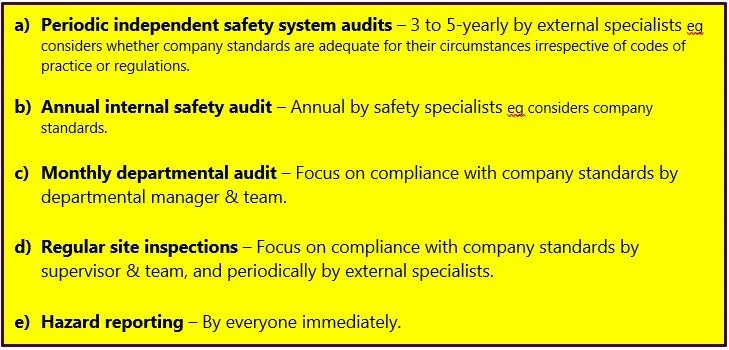
Another way of thinking about safety audits and their respective roles is to think of a “funnel” which hopefully could let us know about deficiencies in our safety program, before a serious accident happens eg:
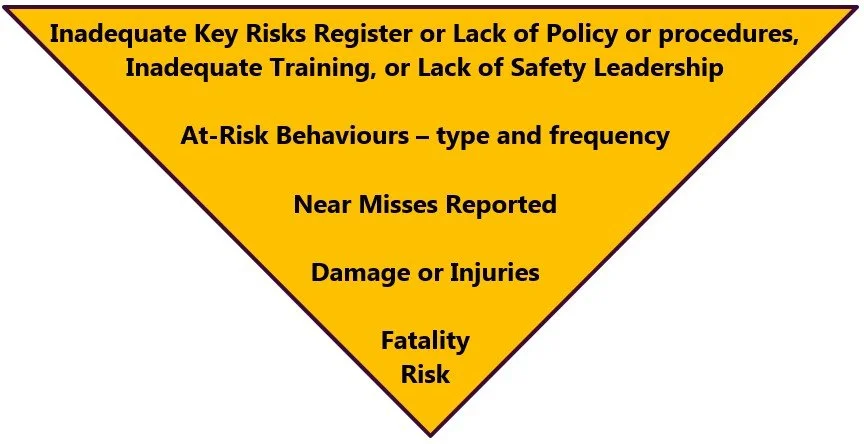
The above diagram shows possible indicators at different levels that if used correctly should help identify safety deficiencies before a serious incidents occurs.
Site Audits Focus on Site Conditions
Firstly, site audits should and do focus on site safety and compliance with established company rules, and therefore will correctly report observations like unsafe site conditions and unsafe work practices.
Site safety audits are intended to be brief as they should be conducted frequently and focus on compliance with the company’s established standards.
Site audits do not question whether Parliament has passed what you might think is the best safety legislation, or whether the relevant minister has promulgated appropriate safety regulations or whether WorkSafe has published enough or correct guidance in codes of practice.
In site audits it is only considered safe if it is compliant with company standards
Safety Systems Audits
When the business wants to know if their systems and safety standards are adequate they conduct a company-wide safety systems audit, either internally with company safety team if available or by external specialists.
Systems audits are the correct process to review company procedures and safety standards.
Safety Culture Audits
In recent years there has been an increased interest in the effect of a poor safety culture on the business safety performance, and therefore increased desire for advice on how to build a strong safety culture.
In addition to appropriate safety policies, procedures, training and reward & check systems, experience tells us we need all workers to understand and believe that the business genuinely wants everyone to follow the agreed procedures and stop and escalate if this cannot be done safely. This is where safety culture comes in, but is rarely included in safety audits.
One tool that can be helpful to gain a preliminary understanding of the safety culture is to include a safety climate survey as part of the safety audit program. Typically, safety climate surveys are conducted as part of the independent audits or annual internal audits.
Some common safety climate survey questions include:
Are there any serious uncontrolled safety hazards in your work area?
Do all workers follow the agreed safe work procedures all the time? If not why?
Would you be criticised if you stopped an unsafe activity?
Is your supervisor serious about your personal safety?
Do you believe our business is genuinely committed to workplace safety?
Summary
Our suggested approach is summarised below.
Schedule safety audits at each level with appropriate personnel responsible for completion and follow-up.
Fix the problems that are found in audits - promptly.
Look for patterns of deficiencies from audit results eg systemic causes.
Encourage all staff to consider adequacy of company standards.
If interested in making your safety audits more effective book your key personnel into our 2-day safety leadership foundation course 7th & 8th October, or one of advanced workshops.