
Working on Safety Conference
What Will Safe Work Look Like in 2036?
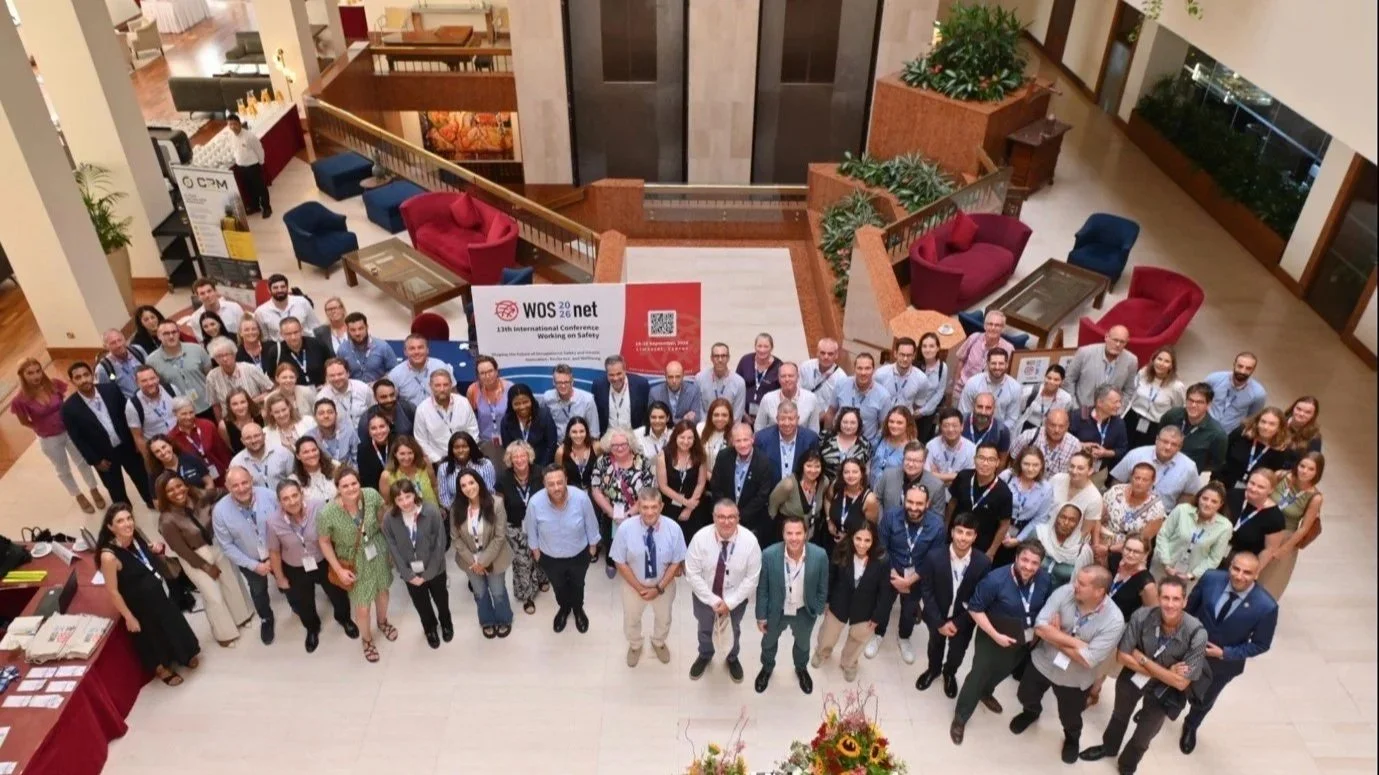
The International Working on Safety (WOS) 2026 conference brought safety researchers, academics and practitioners to Cyprus from around the world to consider how occupational safety and health must respond to a rapidly changing world of work.
One question that was asked during the conference: Is the world changing faster than we can keep up with keeping people safe?
Artificial Intelligence (AI) is increasingly supporting workplace decisions. People are working alongside robots. Wearable technology can monitor workers and environmental conditions. Digital twins allow us to model workplaces and hazards before physical changes are made. Climate change is altering workplace exposures, and remote and internationally connected work is challenging even our traditional definition of a “workplace”.
Key themes re-enforced during the WOS conference:
The workplace is changing faster than conventional safety systems. AI, robotics, digital twins, remote work, climate change, demographic change and psychosocial hazards mean that the assumptions behind traditional controls are shifting.
Human-centred safety is becoming more important. There is no meaningful “average worker.” Age, neurodiversity, physical capability, cognition, psychological state and individual circumstances all affect how work is experienced.
Technology creates a dual effect. Automation, sensing, wearables, digital twins and AI can remove exposure and predict problems, but they can also introduce new hazards, technological stress, loss of autonomy and unfamiliar failure modes.
Participation has to involve power, not just consultation. Co-design, worker-led investigation, stop-work authority and genuine joint decision-making are substantially different from simply asking workers for feedback.
Complexity is a recurring implementation problem. Standards and regulations can contain excellent requirements and information, but that does not mean those requirements reach the person purchasing, installing, operating or maintaining equipment.
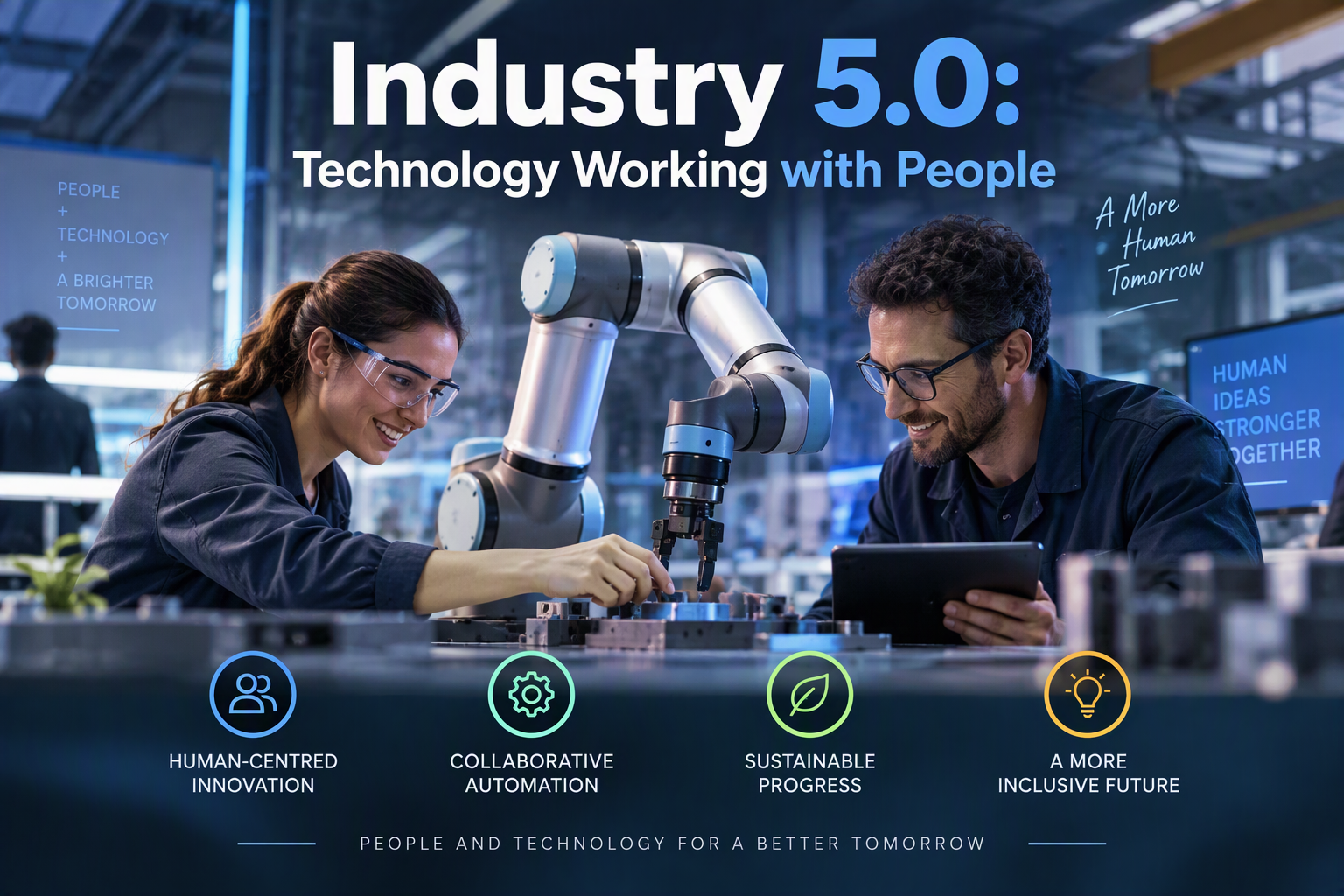
A concept discussed throughout the conference was Industry 5.0. It builds on the automation and digitalisation associated with Industry 4.0, but places greater emphasis on human-centred, sustainable and resilient work.
Rather than simply asking how technology can make work faster or more productive, Industry 5.0 asks how technology can work with people to create better and safer work.
Examples include collaborative robots (cobots), AI, wearable devices, exoskeletons, sensors and digital twins. These technologies can remove workers from hazardous tasks, reduce manual handling, detect changing conditions and allow risks to be assessed before people are exposed.
But another side to this transformation. Technology can also introduce unfamiliar failure modes, information overload, technological stress, concerns about autonomy and new psychosocial risks.
For safety professionals, this creates an important principle:
Technology should adapt to and support people - not require people to adapt to the technology.
Designing For People, Not The “Average Worker”
Another strong theme was the changing workforce. Traditional workplaces, equipment and safety controls have often been designed around an assumed “average” worker. In reality, there is no meaningful average person.
Our workforce includes different ages, physical capabilities, cognitive characteristics and levels of experience. Greater recognition of neurodiversity and psychosocial health also challenges us to think differently about how people interact with work.
Human-centred safety therefore means considering the variability of real people when designing work, rather than expecting everyone to fit a predetermined system.
This connects strongly with Industry 5.0: technological advancement should be accompanied by better human factors and worker-centred design.
Technology: Both A Safety Control And A New Source Of Risk
There was considerable discussion about whether AI and automation will ultimately make work safer.
There are significant opportunities. Robots can perform work in heat or hazardous environments. Automation can reduce manual handling. Sensors and wearables can monitor heat exposure, worker health and lone work. AI may identify patterns and potentially help organisations move from reactive safety management towards earlier identification of risk.
Digital twins offer another interesting opportunity: modelling equipment, workplaces and human tasks digitally so hazards and human-factor issues can potentially be identified before changes are physically implemented.
However, every technological intervention needs to be considered as a change to the work system. Does eliminating one exposure introduce another? What happens when technology fails? Does automation reduce a worker’s understanding of the process? Does constant digital connectivity create additional workload or stress?
Innovation therefore needs risk management alongside it, not after it.
Participation Must Mean More Than Consultation
Worker participation was another recurring theme.
Simply asking workers what they think is not necessarily genuine participation. More meaningful approaches discussed at WOS, and reminded by Constance, included co-designing controls, joint decision-making, worker-led investigations and giving workers genuine authority to stop unsafe work.
This is particularly important as work becomes more technologically complex.
The people performing the task often understand aspects of real work that are not visible in a procedure, risk assessment or digital model. The future of human-centred safety therefore requires workers to be participants in designing the system, rather than simply recipients of controls developed elsewhere.
The Continuing Challenge: Turning Knowledge Into Practice
The theme that connected with our work at Safety Action was the gap between knowing what good safety looks like and actually implementing it.
We already have access to extensive research, legislation, ISO standards, technical standards and guidance containing excellent safety requirements. But complexity itself can become a barrier.
A requirement contained somewhere within hundreds of pages of a standard does not automatically reach the engineer designing equipment, the person writing the purchase specification, the contractor installing it, the supervisor managing the work or the worker operating it.
One presentation captured this relationship particularly well: research generates and refines knowledge; standards and education turn knowledge into action; and partnerships turn action into wider impact.
That is also an important challenge for safety practitioners.
Our role increasingly involves being a translator between evidence, standards and real work, taking complex requirements and making them practical, understandable and usable.
So, What Does Safe Work Look Like In 2036?
For me, a most interesting question posed to WOS was:
“What do we actually want a safe workplace to look and feel like in 2036?”
A worker should feel physically secure, psychologically safe, valued, confident and able to perform meaningful work.
That doesn’t necessarily mean removing every challenge or source of pressure. Good work can be demanding and still be rewarding. The desirable state is — work that is sufficiently challenging to be engaging, but not so demanding that it becomes overwhelming.
The same principle applies to physical safety. We should use good design and higher-order controls to prevent serious exposure, while maintaining the worker’s understanding of the system and ability to recognise hazards and know when something is abnormal.
The challenge ahead is therefore bigger than introducing new technology or writing more safety requirements.
It is about creating human-centred systems where technology, good design, worker participation and evidence-based safety work together.
My WOS Presentation: Making Machinery Safety Standards Work In The Real World
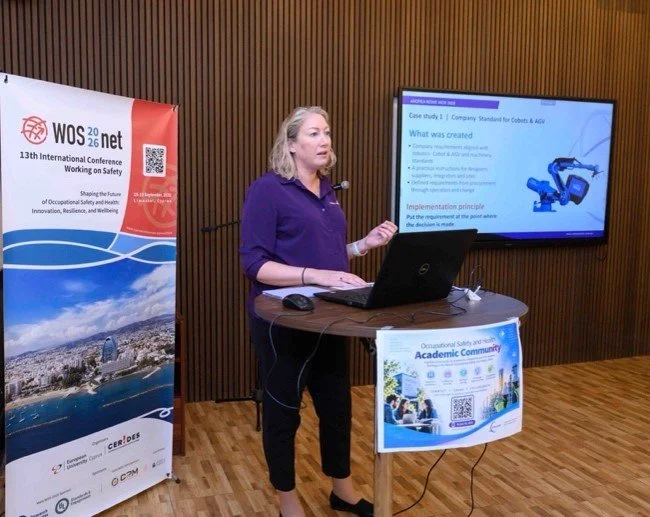
Andrea Rowe presenting at the WOS Conference
My presentation addressed a problem I encounter regularly when working as a safety consultant.
We have access to good safety requirements- Machinery safety standards, International Standards Organisation (ISO) and Australian standards and workplace heath & safety (WHS) laws containing detailed requirements for designing, purchasing, installing, operating and maintaining safe equipment.
The problem is not a lack of clear requirements.
The problem is turning thousands of requirements into something people can actually use.
It is common for a machinery procurement specification to specify that equipment must comply with specific ISO standards and WHS legislation. Yet when the machine arrives, relatively simple requirements may still have been missed.
I used the example of receiving new machinery with an unlabelled emergency stop. The contractual requirements were there. The regulatory requirements exist- it is a legal required in Australia for emergency stop buttons to be labelled. Yet the finished machine did not meet them.
How does something so obvious get missed?
Often it is because the requirement has not been translated into specific checkpoints throughout the machinery lifecycle.
I presented two practical examples of addressing this.
The first involved having clear company standards for machinery robots and collaborative robots (cobots). Rather than simply referring users to complex standards, the requirements need to be translated into practical instructions and checklists covering procurement, acceptance testing, on-site implementation and training.

The second example was Zero Access, a global machinery safety programme originally piloted across nine countries to address serious injuries and amputations.
The approach deliberately changed the way people looked for hazards. Participants were encouraged changed their mindset and to think like an “inquisitive monkey” trying to reach something inside the machine: climb around it, look underneath it, investigate infeed and outfeed points and find every possible way of reaching hazardous moving parts.
The programme used simple tools (including the ‘monkey finger’ tubing and simple checklist), multidisciplinary teams and practical training on the factory floor, rather than expecting workers to navigate an entire machinery standard.
Thousands of previously unidentified hazards were found during the pilot, many relatively inexpensive to correct. The programme subsequently achieved a very substantial reduction in serious machinery injuries, and trained participants became trainers themselves, spreading the approach through their workplaces and regions. Similar, significant reduction in hazards and injuries has been found by many of our clients following implementation of Zero Access workshops and most importantly, tracking the hazard solutions.
The lesson from both examples is straightforward:
Don’t leave safety requirements sitting inside a standard or specification. Build them into procurement, design, installation, operation, maintenance and verification, and make the information usable by the people who actually need it.
Email us for more information about Zero Access workshops.
My Key Takeaway From WOS26
Despite the diversity of research presented at WOS — AI, robotics, psychosocial health, leadership, digitalisation, human factors and Vision Zero — kept coming back to one common issue:
How do we translate knowledge into action?
Research helps us understand risk. Standards convert knowledge into recognised requirements. But neither automatically creates a safe workplace.
Those requirements still need to be translated into design, procurement, procedures, training, simple tools, worker participation and verification.
Perhaps that is one of the most important challenges for the safety profession over the next decade.
The future of safety may not depend on creating more information. It may depend on becoming much better at turning what we already know, together with what we are continuing to learn, into the way work is actually done.
Next Month Andrea will share about Vision Zero and ISSA